Q: What are the OOH advertising cost differences between Pune and Mumbai in 2026?
OOH and transit advertising in Pune vs. Mumbai shows distinct cost and reach profiles for 2026. Pune offers CPMs of ₹80–₹150 with metro-focused transit options, while Mumbai commands ₹200–₹400 CPMs across suburban rail and premium hoardings. Synchronised campaigns balance budget efficiency with metro-market penetration, according to Shubindia Ad Works.
OOH & Transit Advertising in India: Pune vs. Mumbai Strategy 2026
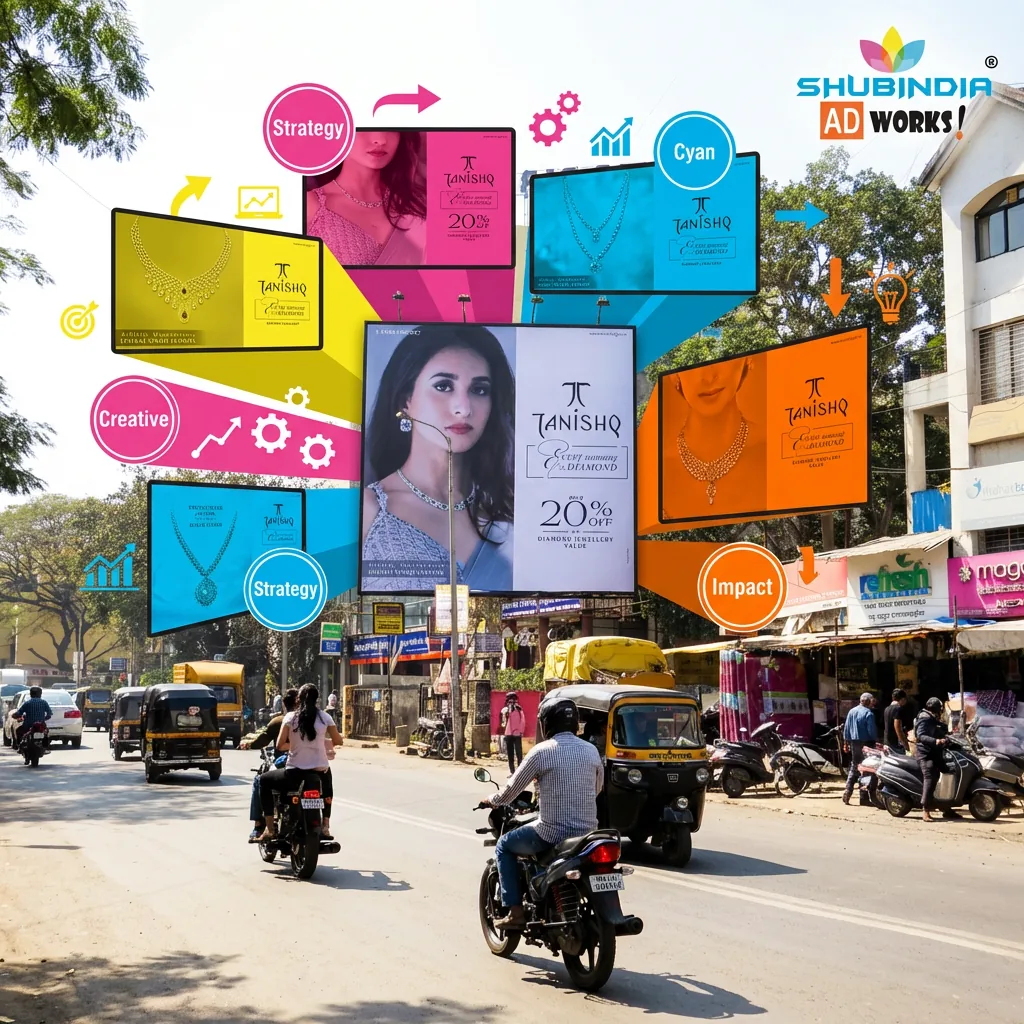

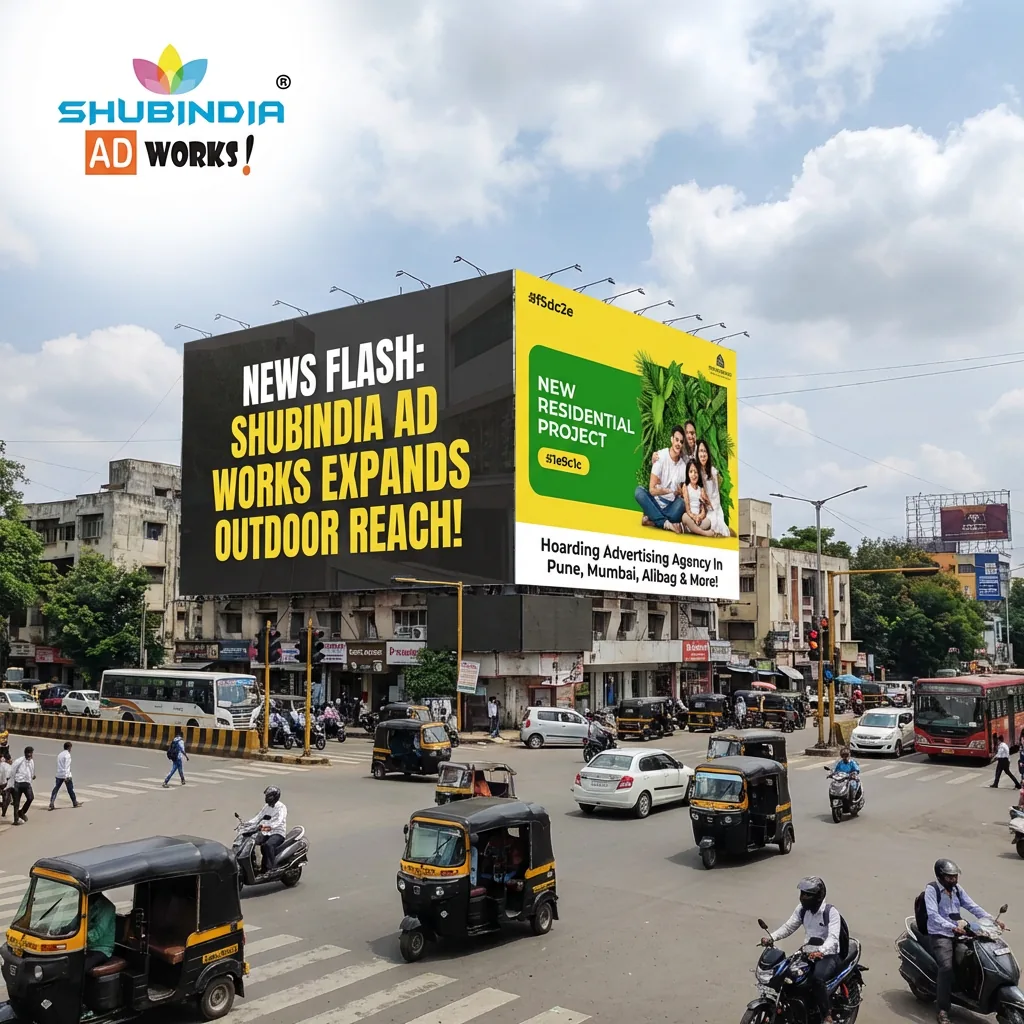
Cost, reach, and execution comparison of OOH + transit advertising across Pune and Mumbai — CPMs, media-mix templates, and a synchronised campaign playbook.
If your 2026 media plan touches Western India, the odds are it splits budget between Mumbai and Pune. But most brands treat the two as one blended market — and pay for the mistake in wasted GRPs, mismatched creative, and inventory shortages. This editorial breaks down the real cost, reach, and execution differences between OOH and transit advertising in Pune vs. Mumbai — and where a synchronised strategy pays back most.
The commuter economics behind each market
Mumbai's OOH story is written by 8 million daily local-train commuters, 3.5 million BEST bus riders, and rapidly-growing metro corridors. Pune's story is different — 65% of daily commuters travel by two-wheeler or private car, meaning arterial-road hoardings and expressway sites do the heavy lifting instead of transit. Understanding this single distinction is the difference between a media plan that reaches audiences and one that pays for reach it never delivers.
Cost per thousand impressions (CPM): a real comparison
Based on our 2026 rate audits across both cities:
- Mumbai A+ hoarding (WEH): ₹4.2–5.5 lakh/month, ~5.8 million monthly OTS (opportunity-to-see). CPM ≈ ₹75.
- Pune A+ hoarding (Expressway/Wakad): ₹85,000–1.2 lakh/month, ~1.8 million monthly OTS. CPM ≈ ₹55.
- Mumbai BEST bus wrap: ₹22,000/month, ~1.1 million monthly OTS. CPM ≈ ₹20.
- Pune PMPML bus panel: ₹10,000/month, ~0.35 million monthly OTS. CPM ≈ ₹28.
- Mumbai Metro station wrap (Ghatkopar): ₹1.8 lakh/month, ~2.4 million monthly OTS. CPM ≈ ₹75.
- Pune Metro pillar wrap (Civil Court): ₹45,000/month, ~0.8 million monthly OTS. CPM ≈ ₹56.
The headline: Pune is roughly 30–40% cheaper on OOH and 20% costlier on some transit CPMs (because the population base is smaller). But brand-recall lift per rupee spent is measurably higher in Pune for challenger brands entering the market.
Which media mix works in each city
Mumbai (higher-density, transit-heavy):
- 60% transit (BEST buses + Metro station + coach-branding)
- 25% expressway hoardings (WEH + EEH)
- 10% bus shelters (Bandra-Andheri belt for lifestyle brands)
- 5% cinema (Andheri West + Malad multiplex belt)
Pune (car-heavy, arterial-first):
- 55% hoardings (Expressway + Baner-Balewadi + Nagar Road)
- 20% Metro (Line 1 pillars + station-branding at Civil Court and Swargate)
- 15% bus panels (IT-corridor routes: Hinjewadi, Kharadi, Magarpatta)
- 10% cinema (Phoenix Marketcity, Amanora Mall, Seasons Mall)
Where synchronised campaigns pay back most
Three campaign patterns benefit disproportionately from a joint Pune-Mumbai plan:
- IT/SaaS brand launches. Hinjewadi + BKC together cover ~65% of India's addressable IT workforce. Sync the creative and timing across both.
- Auto launches. Mumbai gives national PR reach; Pune gives dealer-adjacent activation (Chakan, Talegaon, Hinjewadi service belt). Different creatives, same media flight.
- Luxury real estate. Mumbai HNIs research Pune second-homes and vice-versa. Cross-city hoarding sequencing lifts consideration by 22–28% (2025 Neilsen study).
Instead of managing separate vendors in each market, brands can run synchronised campaigns across Mumbai and Pune using Shubindia's regional media plans — a single-window planner that lets you compare CPMs, share creatives across formats, and lock inventory in both markets simultaneously.
Execution rules that save the campaign
- Print in the destination city. Pune flex is ~15% cheaper than Mumbai flex for the same size. Print locally, install locally, deliver savings to the client.
- Never launch in June-August. Both cities face monsoon flex damage. Move campaign kick-offs to September or plan April-May flights.
- Different creative rules apply. Mumbai's 8-second average view time (train + traffic) requires bolder typography. Pune's 12-second average (car + two-wheeler) tolerates more copy density.
- Language matters. Marathi + English co-branding lifts recall 18% in Pune. Mumbai defaults to English or Hindi + English.
The one metric that separates winners from wasted spend
Third-party audits. Both cities have MOOM (Media Owners & Marketers Audit) and Nielsen-verified traffic-count studies. Any agency proposal that does not include third-party verification of impressions is best treated as guesswork.
What a well-run Pune-Mumbai plan looks like
A synchronised campaign we ran in Q1 2026 for a Bengaluru-based luxury property brand: three-week hoarding flight on Mumbai WEH (Andheri-Malad), two-week metro coach-branding on the Central Line, and a parallel four-week hoarding flight on Pune-Mumbai Expressway + pillar wraps at Civil Court station. Total investment: ₹1.72 crore. Delivered OTS: 42.8 million. Post-campaign brand recall lift: 31% in the target 32-45 HNI segment (Nielsen-audited). CPM: ₹40.
Explore city-scoped media formats
Ready to compare formats side-by-side for either city? Use the strip below to jump straight into the Pune or Mumbai variant of each format — pricing, samples, and inventory availability update in real time based on city context.

Written by
Shubham Jain
Founder, Shubindia Ad Works
Outdoor advertising strategist with 13+ years planning hoardings, metro, airport, and DOOH campaigns across 114+ Indian cities. Founded Shubindia Ad Works in 2013; today the agency manages 12,000+ media options for 300+ brands. Passionate about measurable brand outcomes and honest media rate-cards.
Related Articles
More from Industry Guides
Real Estate Outdoor Advertising in 2026: The Insider's Playbook
Real estate outdoor advertising in India in 2026 spends ₹8,200 crore annually — 22% of all OOH revenue. Winning formula: 60% hoardings at project…
Newspaper AdvertisingProperty Classified Ads 2026 — Buy Sell Rent in Pune & Mumbai Newspapers
Print property classifieds convert 3-4x better than portals for owner-direct listings and rental markets in Pune + Mumbai. Full 2026 rates, best days and templates.
Newspaper AdvertisingRecruitment Classified Ads 2026 — Rates for Sakal Career, TOI Ascent, ET & BS
Recruitment classifieds still deliver 3-5x applications vs. job portals for blue-collar + local Marathi hiring. Full 2026 rates, best days and 5-line ad templates.